Broadcasting Standards Authority subverts its own legislation

The Broadcasting Act 1989 contains a set of standards including that:

“When discussing controversial issues… broadcasters should make reasonable efforts, or give reasonable opportunities, to present significant points of view either in the same programme or in other programmes within the period of current interest.”

Parliament’s intent in setting the standards is clear to any reasonable person. Unfortunately the Broadcasting Standards Authority (BSA) has trouble attaining such clarity. Perhaps it is the years of being subject to obfuscatory argument by broadcasters. Or perhaps its their attempt to create some sort of pseudo-legal “case-law” in their own irrational decisions over the years that has confused them. Either way they can no longer see the wood for the trees. Indeed even the trees seem to be a challenge.

A Campbell Live item on euthanasia back in April was a clear example to any reasonable person of why our Parliament enacted the standards legislation and established the BSA to oversee it. The item gave a very sympathetic hearing to two strong advocates of euthanasia, with only a cursory acknowledgement that other viewpoints exist. No reasonable opportunity was given to present those viewpoints, either within the item or in any other coverage by the broadcaster at the time.

In taking a complaint through the BSA process the clear intent of Parliament as outlined in the Act enabled a clear, well reasoned rejection of every illogical, and irrelevant argument mounted by Mediaworks in defence of their item (refer BSA – Campbell Live Euthanasia Story and BSA – Campbell Live Euthanasia Story – Final Comment).

In spite of that, the BSA managed in its decision published this month to not only agree with the broadcaster, but also to find some other completely irrelevant grounds for influencing their decision on the Campbell Live item. Apparently the Bill of Rights Act protection of freedom of expression meant they had to be cautious about “interfering with the item’s broadcast”. Not even Mediaworks had thought to argue this line.

No-one was suggesting that the item should not be broadcast, only that it should meet the standards of the Broadcasting Act. Freedom of expression is simply not relevant to the case. Or if it is, it is relevant only in the sense that other significant views were not allowed the freedom of expression required by the Broadcasting Act.

The Broadcasting Standards Authority has lost the plot. One is reminded of another statutory body set up to oversee legislation – the Abortion Supervisory Committee. Both have subverted the clear intent of the legislation under which Parliament established them.

Ewen McQueen
October 2012

Posted in Cultural Renewal, Respect for Life | Tagged , | Leave a comment

Feed the children ?

Labour leader David Shearer last week announced a new education policy initiative – feeding children in low decile schools across New Zealand. Labour has costed it at $19million per annum. Hone Harawira was promoting the same initiative as Mana Party policy during last year’s election. KidsCan announced today that by working jointly with the private sector and government agencies they could do it for a mere $4million per annum.

Even at $19million it is a drop in the bucket of public expenditure – however it is a drop that would have a positive ripple effect across the entire education budget. Why spend billions trying to teach hungry children who can’t even concentrate? This is a simple, straightforward policy that would have a strong impact, leveraging the existing investment in the sector. And it could be done without the need for any extra policy analysts at the ministry, or any more frameworks….etc etc

Yes we need to address the underlying drivers of child poverty – in particular the breakdown of family life. However that is a long term generational task. In the meantime let’s feed the children – it’s a bargain.

Ewen McQueen
September 2012

Posted in Economic Transformation, Protecting Children | Tagged , , | Leave a comment

Will Tuhoe now sign the Treaty ?

Another major Treaty settlements milestone passed today with Tuhoe deal announced. Among other things it includes  $170million in redress and co-management of Te Urewera National Park. However it was a milestone with an important difference – Tuhoe have never actually signed the Treaty of Waitangi. And it raises the obvious question – will they now sign it ?

Historically the Crown has dealt with all Iwi as as if they had signed the Treaty, even if they had not. This was a specific policy decision taken early in New Zealand’s adminstrative history. Whilst it was taken as a good faith decision on the part of the Crown, where the Treaty was itself dishonoured by the Crown then non-signing Iwi were often the victms of injustice just as those who signed it were. Tuhoe was among them.

However times have changed and today the good faith of the Crown has worked on behalf of Tuhoe even though they are not Treaty signatories. Perhaps its time Tuhoe formally acknowledged that they too are citizens of New Zealand, and agree to “give absolutely to the Queen of England forever the complete government over their land”.  (Professor Sir Hugh Kawharau’s translation of the Maori version of Article 1 of the Treaty).

In 1908 the Tuhoe chief Rua Kenana came down from his mountain stronghold to discuss matters of state with then Prime Minister Sir Joseph Ward. In response to Rua’s questions about the issue of sovereignty, Ward replied – there can only be one sun in the sky.

That was why the Treaty was signed in 1840. It remains true today.

Ewen McQueen
September 2012

Posted in Cultural Renewal, Spiritual Renewal, Treaty of Waitangi | Tagged , | Leave a comment

Child poverty report – still ignoring the obvious

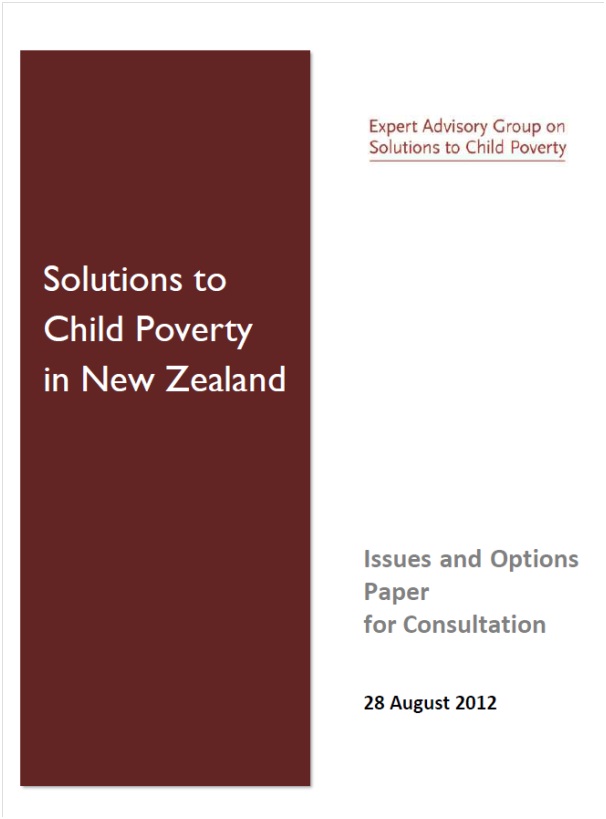
The Office of the Childrens Commissioner published another report on child poverty today – “Solutions to Child Poverty in New Zealand – Issues and Options Paper for Consultation”. It rightly points out the major problem we have in this country with child poverty, and no doubt has some useful ideas.

However it continues to ignore one of the major contributors to the growth of child poverty – family breakdown. It notes on page 1 that ” Children in sole-parent families experience significantly higher poverty rates than those in two-parent families (56 percent and 13 percent respectively in 2011)”. But it ignores this obvious policy target in its approach to solutions.

Instead we get references to the UN Convention on the rights of the child, the Treaty of Waitangi, and “the complex, multi-faceted nature of child poverty, and the need for an integrated and comprehensive package of measures if solutions are to be effective”

What about measures to rebuild strong family life ? How about policy that affirms the institution of marriage which evidence clearly shows provides better outcomes in terms of family resilience and economic security. When children have both a mum and a dad they are far more likely to have an earner in the household, rather than just one parent struggling on welfare.

The debate on child poverty is not new. Fifteen years ago I contributed to the NZ Herald on the topic (refer Poverty: it’s not a lack of jobs, it’s a lack of fathers). So many years on and we are still ignoring the obvious.

Ewen McQueen
August 2012

Posted in Cultural Renewal, Economic Transformation, Honouring Marriage, Protecting Children | Tagged , , | Leave a comment

Key simplistic on euthanasia

Last week Prime Minister John Key came out publicly in support of voluntary euthanasia, suggesting it was already happening in our hospitals. His comments were based on the fact that doctors sometimes have to make difficult decisions about ceasing life-support in terminal situations. However this is not euthanasia and Key’s suggestion that it is brought a strong response from medical specialists in palliative care.

The chair of the Australian and New Zealand Society of Palliative Medicine said Key was “misrepresenting” the care of terminal patients and suggesting doctors were acting illegally and unethically.  Even Maryan Street the Labour MP promoting a members bill to legalise euthanasia noted that Key had got it wrong. She was clear that what she wanted was a step much further – the right of individuals to request medical staff to assist them to take their own lives at a time and place that suited them.

To his credit the PM today admitted his comments were a bit “sloppy” and that he never intended to suggest doctors were acting illegally. However his comments not only showed a misunderstanding of what euthanasia is, but they also displayed a simplistic approach to the issue. Simply saying, as Key did, that if he was terminally ill and in pain he would want someone to end his life, suggests he has given little thought to the wider implications of what he is endorsing.

Legislation nearly always carries a cultural message that will impact well beyond its apparent ambit. The message that legalised euthanasia will infuse into our culture is clear – there is such a thing as a life not worth living. In a country with one of the highest youth suicide rates in the world, why would our political leaders promote such a concept?

Ewen McQueen
August 2012

Posted in Cultural Renewal, Respect for Life | Tagged , , , , , | Leave a comment

A doctor with courage

When the Southern DHB decided to start undertaking abortions at Southland Hospital in Invercargill they didn’t expect resistance from their own staff. However last week senior paediatrician Dr Vili Sotutu tendered his resignation over the matter and other doctors at the hospital were also reportedly unhappy (Fairfax NZ News Stuff.co.nz 04.08.12).

Thankfully his resignation was not accepted. The health system needs more staff with his courage. Doctors, nurses and managers who reject the notion that taking human life should simply be accepted as a normal part of their job.

The Southern DHB clearly doesn’t see listening to its community as part of its job on this matter. Over 200 people turned up at a meeting in June to oppose the move. Board members were invited but did not attend.

Ewen McQueen
August 2012

Posted in Protecting Children, Respect for Life | Tagged , , | 1 Comment

An uncommon hope

Last week another four Treaty settlements had their final reading in Parliament. Among others, East Coast iwi Rongowhakaata and Ngai Tamanuhiri received Crown apologies and redress for violent and tragic Treaty breaches in the 1860s.  The claims settlement bills passed quietly and unanimously. There was little media interest. Conflict is headline news (witness the recent controversy over asset sales and the Waitangi Tribunal). However justice and honourable settlement is not.

It is unfortunate, for such moments in the Treaty settlement journey throw up the best of what Parliament can be. It becomes a place of honour, respect, honesty, and humility. MPs from across parties contribute with dignity and sincerity. As the public gallery fills with waiata at the end of each final reading, one is left with an uncommon sense of hope and optimism for our nation.

There are few nations where such a journey has even been attempted. In the main deeply held grievances between peoples remain just that – deeply held, with occasional violent flare ups. Croatia, Serbia, Rwanda, Iraq, all come to mind.

Yet in this land of ours a painful history is being re-opened, re-told and to the extent that it is possible – resolved. It is a unique and wonderful journey that flows against the normal tide of human history.

Perhaps we should not be surprised. There is One who was a witness at the signing of the Treaty, who was witness for Rongowhakaata and Ngai Tamanuhiri, and who hears the petition each time the Parliamentary mace is carried into the debating chamber….

Almighty God, humbly acknowledging our need for Thy guidance in all things, and laying aside all private and personal interests, we beseech Thee to grant that we may conduct the affairs of this House and of our country to the glory of Thy holy name, the maintenance of true religion and justice, the honour of the Queen, and the public welfare, peace, and tranquillity of New Zealand, through Jesus Christ our Lord. Amen.”

Ewen McQueen
August 2012

Posted in Cultural Renewal, Economic Transformation, Spiritual Renewal, Treaty of Waitangi | Tagged , , | 1 Comment

She thought the baby had a tummy bug…

Leilani Lotonu’u-Lorigan aged two died last month in Manurewa. Her mother’s boyfriend was last week charged with murder. He had moved in with Lelani’s 19 year old mother and her baby sister six months prior.

Leilani’s grandmother said “Leilani died from septicemia from two ruptures in her bowel and passed away in her “mother’s arms”. She never made it to the hospital… she died in my granddaughter’s arms. She thought the baby had a tummy bug,” (Fairfax NZ News – Stuff.co.nz 12.07.12).

As our political leaders consider an action plan to protect vulnerable children (refer Green Paper submission) they need to escape their tunnel vision on social agency response and look instead at culture – relationship culture. Why  have we abandoned our young people to such a dangerous casualisation of human relationships? Why have we allowed social values and norms to become embedded that accept “revolving-door” families where mum’s latest boyfriend comes and goes, and where children are at greatly increased risk of abuse?

And as Jim Hopkins pointed out in a recent NZ Herald column  (“The only consistency around is the inconsistency” – NZ Herald 29.06.12) – why do our political leaders not see the obvious contradictions? On one hand they have state agencies struggling to deal with child abuse, whilst on the other state owned TV channels and NZ on Air produce and broadcast programmes that glamorise and normalise the casualised relationship culture which gives rise to such abuse.

Page 7 of “Strong Families: Thriving Children – Submission on the Green Paper for Vulnerable Children” has a table of child deaths in New Zealand over the last five years. Of the 23 deaths listed, 21 involved children in households where the adults were not in a stable married relationship. In most of those cases (17) the person convicted, charged or a suspect was not even the biological parent of the child. Sadly Leilani adds another name to that list.

The Government is now preparing a White Paper with specific policy proposals on protecting vulnerable children. Rebuilding a culture which affirms marriage and commitment is an obvious and urgent policy target. Will they take aim?

Ewen McQueen
July 2012

Posted in Honouring Marriage, Protecting Children | Tagged , , | Leave a comment

Generational Politics

There is friction this week between National and the Maori Party over Iwi interests in water rights and Prime Minster John Key’s unforunate comments re the Waitangi Tribunal. To be fair, Key didn’t say the Government would ignore the Tribunal, simply that its decisions were non-binding on the Crown. However  as Pita Sharples and Tariana Turia have rightly pointed out – the timing of the comments at the beginning of the Tribunal’s hearing on this issue were not helpful. The Tribunal and the process it oversees deserves the respect, if not always the agreement of the Crown.

However the issues here run deeper than water and the Waitangi Tribunal. The Maori Party’s discomfort with the partial sale of state owned enterprises is the underlying driver of this week’s friction. In a sense two different world-views are running up against each other. One which seeks a balanced budget in the near term. The other which looks beyond both economics and political cycles to generational stewardship. One is reminded of Cornwall Park and Sir John Logan Campbell.

Ewen McQueen
July 2012

Posted in Cultural Renewal, Economic Transformation, Treaty of Waitangi | Tagged , , , , , | 1 Comment

This our fathers did for us…

Last week floral tributes appeared at the entrance to Cornwall Park commemorating 100 years since the passing of Sir John Logan Campbell one of the founding fathers of Auckland. Sir John owned the land that is now Cornwall Park and originally planned to build his own residence there. However in 1901 he gifted it to the people of Auckland during the visit of the Duke and Duchess of Cornwall.

Cornwall Park now stands as a testament to long-term, generational thinking. For over a century it has been a place of beauty, serenity, and refeshment for the soul. Whilst all around it the land has been divided, developed and on-sold many times over for gain and more again, the park has remained a bastion against the restless speculative spirit of the city. It exists as land apart – consecrated to a different call. A call to legacy and inheritance.

As we look to renew our nation, Cornwall Park and the noble ideals it represents, are a signpost for us. From our fathers comes a guiding hand for our children and their children. It is not about what we can have now. It is about what we can leave them.

The plaque near the entrance to Twin Oaks Drive speaks of the spirit of the park in a poem adapted from John Ruskin. It ends;  “See, this our fathers did for us!”

Ewen McQueen
July 2012

Posted in Cultural Renewal, Spiritual Renewal | Tagged , , , | Leave a comment