
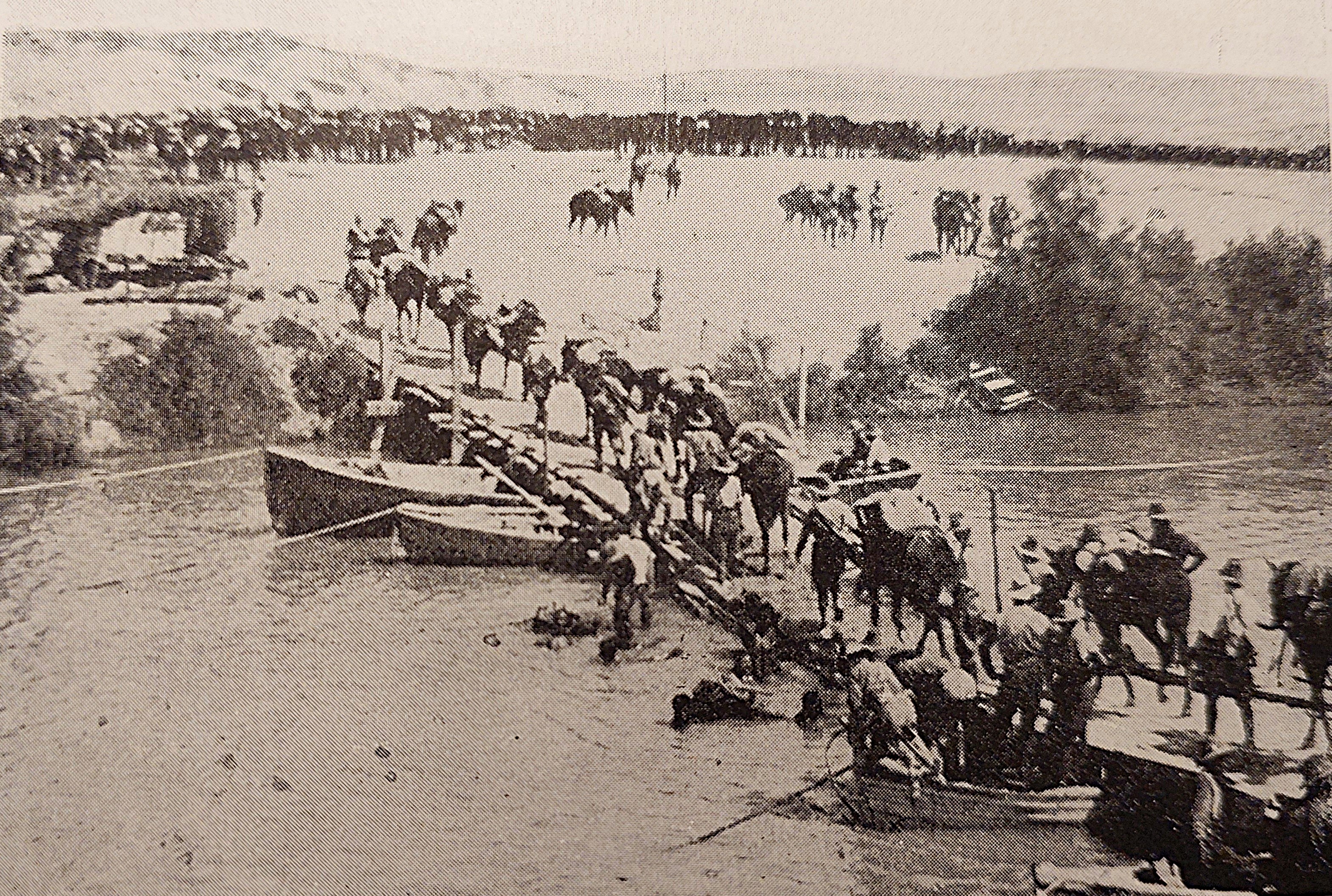
NZ troops cross the Jordan River
It was 9th December 1917. The Jewish celebration of Hanukkah had just begun. It commemorated the liberation of Jerusalem from foreign occupiers in 165 BC. And now, over 2,000 years later, the Holy City was once again being liberated. Ottoman Turk soldiers were fleeing the city as Allied forces bore down on them. Forces which included some of the same ANZACs whom the Turks had defeated in Gallipoli. But in Palestine the tables had turned.
Indeed since early 1916 when the ANZACs had been evacuated from Gallipoli to Egypt and tasked with protecting the Suez Canal, the tide had turned against the Ottoman Empire. It had dominated the Middle East for centuries. But as the Australian and New Zealand forces switched from defence to attack, the Ottoman era in what was then known as Palestine, came to an end.
Together with British forces, the ANZACs swept up the Sinai on horseback and camels and fought fiercely against entrenched Turkish positions. Battles were fought in and around Gaza, Jaffa, Beersheba, Jerusalem, Jericho, Amman and Damascus. The Ottoman yoke was broken and an entirely new geo-political reality was created on the ground. Into that reality the Balfour Declaration of 1917 promised British support for a Jewish homeland.
A month after the Declaration, General Allenby, escorted by a bodyguard of New Zealand soldiers, made his formal entry into Jerusalem. He noted that many Jews who had previously been in hiding to avoid Turkish deportation, now appeared with great enthusiasm. The significance of the timing of the victory was also not lost on Allenby. He wrote:
…inasmuch as the liberation of Jerusalem in 1917 will probably ameliorate the lot of the Jews more than any other community in Palestine, it was fitting that the flight of the Turks should have coincided with the national festival of Hanukah, which commemorates the recapture of the Temple. (1)
For the New Zealanders who fought in the campaign there was the characteristic determination and courage shown so often by the sons of these shores. Lt Colonel Guy Powles records night treks in desert sandstorms to surprise the enemy; bayonet charges across bullet strafed land to capture strategic positions in Rafa, Beersheba, Amman; and the Kiwi captain who led a patrol vehicle behind enemy lines in pursuit of a notorious enemy agent. They rounded a corner on the road near Hebron, ran into the middle of a Turkish infantry company, continued at speed firing all the way, and later arrived in Beersheba to the astonishment of English soldiers guarding that town.
And of course there was also the classic Kiwi ingenuity. At one point the New Zealanders were stationed in Bethlehem, where the nearby ancient Pools of Solomon fed a Roman aqueduct which centuries earlier had supplied Jerusalem. With some smart work and modern technology, the Kiwi army engineers recommissioned the system. Powles records,
So in a short six months after our occupation the city of Jerusalem was in possession of a water supply of 280,000 gallons per day. Not since the days of the Romans has running water been so plentiful in the Holy City. (2)
The New Zealanders were also warmly received by local Christian and Jewish communities in the places they liberated. And unlike some other Allied forces the Kiwis were always welcomed back wherever they returned a second time. Powles records the Mayor of Jewish Richon le Zion sending a letter asking when they would return, and the Christian community of Bethlehem being greatly disappointed at their departure.
And so, as we come to another Anzac commemoration, there is also a history lesson for the New Zealanders who today chant “Free Palestine”. New Zealand has already played a decisive role in liberating the Holy Land. And in the Ottoman defeat the way was opened for those to whom the land was covenanted to begin their long-awaited return. The State of Israel they founded has subsequently become a flourishing and prosperous democracy. And just as Kiwi army engineers reopened the ancient water supply to Jerusalem, we can be proud that our nation played a part in reopening the ancient wells of promise and hope in that sacred land.
Ewen McQueen
April 2026
(1) Lt-Colonel C. Guy Powles, CMG, DSO, The New Zealanders in Sinai and Palestine, Whitcombe and Tombs Ltd, 1922, page 170
(2) Powles, page 225


Well Said,Maurice Charman…..email: Maurice.charman@gmail.comSent from my iPad
LikeLike